“After you have exhausted what there is in business, politics, conviviality, love, and so on — have found that none of these finally satisfy, or permanently wear — what remains? Nature remains…” —Walt Whitman
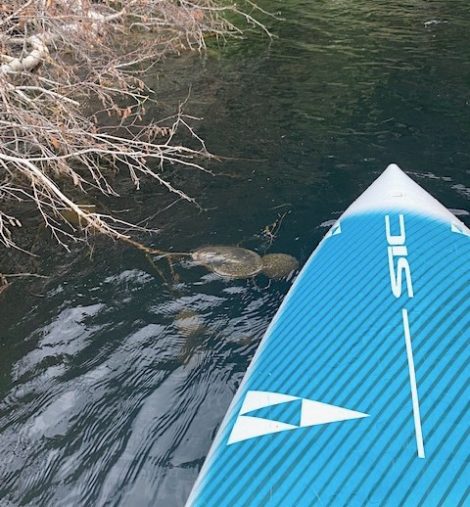
There is a resident snapping turtle in Lake Mansfield. She’s an ancient mama, I imagine, who spends her time swimming and resting and feeding in the vicinity of the public boat launch. At least, that’s where I saw her this summer whenever I set out from there on my paddle board. The first time I paddled on Mansfield, in early June, I accidentally tapped her carapace with the front left side of my board. I vowed not to let myself get distracted from then on, and to be more attentive. I know now to look for her, and looking for her requires looking at everything around. The sensation of both feet firmly on the board, having just pushed out from the shallows, is my cue to wake up and pay attention to nothing but the water, the air, and my precarious place balanced between the two.
Immediately I’m scanning the surface and, over the course of a paddle, either discerning from a distance the small hump of her mossy back, distinct from the undulating water, or catching a quick glimpse of her prehistoric, webbed feet burrowing down, down, down into the water as fast as they can away from me. This summer — whose bug-infested, conflict-ridden spirit I hope to never feel again — the mama snapper in Lake Mansfield taught me that paddling on the water is no place to mourn or plan or worry. It is the place to look and smell and listen.
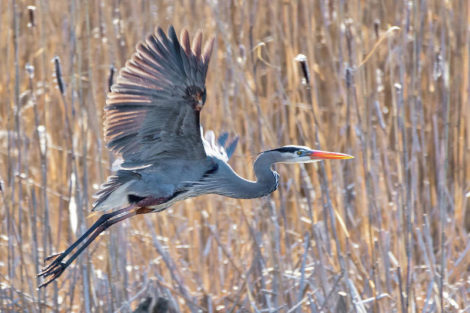
Every body of water around here, so they say, has its snapping turtle, but I’ve never come across one at Benedict Pond in Monterey. It does host a great blue heron, though. I got extremely close to her one morning, so close I could plainly see, for the first time, that great blue herons have a sharp black blaze across the tops of their heads, like the mask of Zorro. In a lifetime of watching great blue herons from a distance as they took flight and flew over the Green River, the Housatonic, and the Williams, I’d always assumed they were, from graceful head to elegant feet, a uniform gray.
One day on my board on the pond, the heron and I played an accidental game of chase. I was paddling out to the southeast, and she was quietly waiting for a fish worth the effort to catch from the reeds 20 or so yards in front of me. This time I must have been louder or messier in my approach, or she more alert, and off she flew before I could come close. She glided ahead another 20 yards, to land between two rocks. But she was pursuing the same watery path I was intending to take, so as I approached again off she flew, and so it went another three times, before she gave up fishing on that side of the pond, and lifted herself just high enough to get above water, her thin, broad wings pumping just enough air to set up a smooth glide to the opposite shore. Bye bye, beautiful heron.
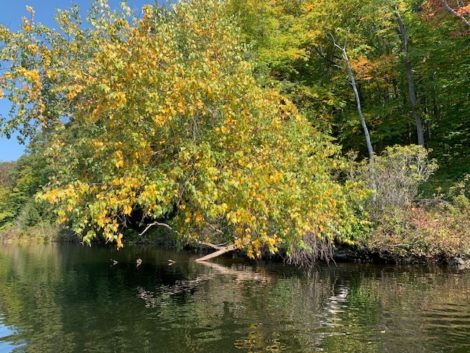
If you’ve been on the water lately at Benedict Pond, you might have noticed a resident white birch tree that must have fallen down in a storm some time in the past two or three years. It’s been lying parallel to the water ever since, but it didn’t die when it fell. In fact, last fall its leaves were just as plentiful, bold, and brilliant as any of the vertically oriented trees along those banks in late September. This year it’s much less alive. Beavers have carved deep gashes in its trunk, and the branches are flimsy, pale and weak, like long-unused arms with atrophied muscles. The pale, paltry leaves left on the branches look on their last legs.
The tree takes on a whole different life under the surface of the water, though. Just submerged and clinging to the ends of many of the branches, are very heavy, very bumpy, partially transparent pouches. I took them at first to be containers for billions and billions of insect eggs. I’ve since learned from Wikipedia that the pouches are actually self-contained creatures, “a colony of organisms that bind together” and either attach to aquatic objects or float free. They are a phylum of bryozoan called Pectinatella Magnifica. They are, I read, “sessile.” I wasn’t familiar with this word, but since I used to teach Latin I correctly guessed that it’s related to the words reside, resident, and residual. They all have the same Latin root, “sedere,” meaning “to sit.” A sessile colony stays in one place, the place in this case being Benedict Pond, where a colony of Pectinatella Magnifica live on a dying birch tree. Bye bye, magnificent pouches. I hope to see you next summer, but imagine I won’t.
I think I should consider my place of residence not as a state or town or neighborhood or house, but a moment. Each moment I spend paddling is one in which my mind is deeply engaged and present. Just the difficulty of balancing on a piece of plastic on top of moving liquid demands my full attention. Even if weren’t also eager not to disturb the water’s inhabitants, I can’t afford to fret on the board. By contrast, while a quiet walk in the woods on solid ground means my mind is theoretically free to be at ease, it rarely is.
My mind on a walk is usually indistinguishable from my mind on all the automatic, obligatory things. Driving, cooking, cleaning, talking, eating, drinking, communing with this wonderful, terrible laptop and its narcotic wifi connection. Ironic, isn’t it, that the only time my mind’s tasks seem mine to choose is the time when I have no choice but to focus on not falling into the water and killing turtles. I wonder what fall, winter, and spring activity can take up the role that paddle boarding played for me this summer.