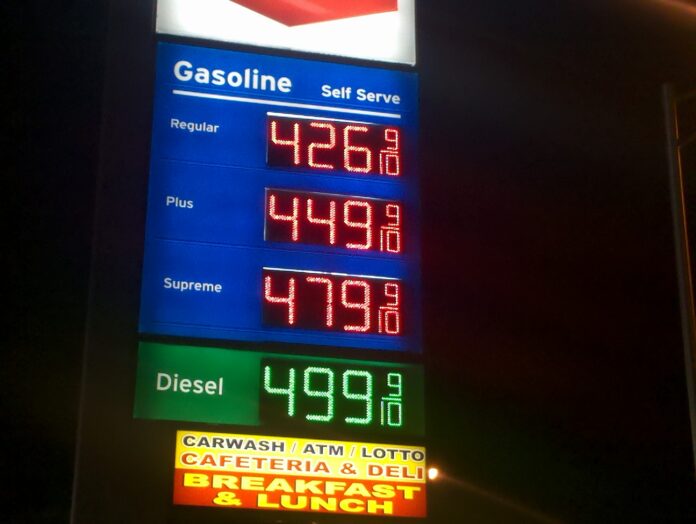
If oil reaches $150 per barrel, gas prices would climb to almost $5 per gallon. To break it down, oil is currently around $100 per barrel, and the national average gas price is $3.70 per gallon. For every $10 increase in oil prices, gas prices rise by about 25 cents per gallon.
Now let’s dig deeper.
Most importantly, war is a human tragedy, and my thoughts are with all our U.S. service people and every innocent civilian. Still, although it feels gross to do so when people are dying and more yet may, I have a job to perform.
Last week, I suggested that investors focus less on predicting the next military headline after the February 28, 2026, joint attack on Iran by the U.S. and Israel and pay more attention to oil prices. I still believe this is the right approach: Energy prices are often the main way war affects markets.
My concern has grown since last week, as U.S. officials announced that Iran has placed sea mines in the Strait of Hormuz—that is a game changer. The Strait of Hormuz shutdown matters because it raises the risk that high oil prices will last longer. Without mines, the disruption might have been more temporary. With mines reportedly in the water, reopening safe shipping lanes could take much longer. This is not unprecedented, and that is part of the concern. Iran mined the strait in the late 1980s during its war with Iraq. Clearing those mines took about six months after the ceasefire—it is a long and difficult process.
Previously, I expected a 17 percent market decline over two to four months, based on Potential Paths #1A and #1B (as outlined in last week’s article). That still stands, but the riskier Potential Path #2 is becoming increasingly likely.
Potential Path #2 was explained as:
If Brent peaks near $150, averages $100 or higher for the first half of 2026, and then trends back to $70 by 2027, the oil shock becomes economically consequential. Months of triple-digit oil would act like a meaningful tax on households and businesses. It would squeeze corporate margins, raise inflation risk, and materially increase the odds that a slowdown becomes a recession. In that world, corporate earnings estimates would likely decline considerably and credit spreads would likely widen (signaling default and recession). In that scenario, I expect the S&P 500 to behave more like a classic recession scare, with a drawdown of 20 percent to 30 percent from its high, and the Nasdaq likely performing worse.
More volatility could be ahead. In my previous article, I assigned a 20 percent chance to Potential Path #2, where Brent peaks near $150. For reference, it peaked at $147 during the 2008 commodity spike; it briefly touched $119.50 on March 9, 2026, ending the week at $104.14. While 20 percent was a reasonable estimate (although, admittedly, not precise), that probability has increased. The exact odds matter (though are unknown), but the trend is even more important.
Commodity price spikes usually happen before recessions, not after.
Markets often seem strongest just before something goes wrong. When everything looks good, people rush into stocks, but eventually, there is no more demand to keep prices up. Commodity prices can behave similarly.
When oil, metals, and other inputs surge, it often signals strong demand relative to supply and buyers then overstock inventory, setting the stage for a decline. But it also means households and businesses suddenly pay more for essentials, which acts like a tax. Oil shocks have often led to slower growth, higher inflation, and tougher policy decisions. It is usually worse when prices rise without strong demand behind them, as is occurring now.
- 1973–1974. The Arab oil embargo followed the Yom Kippur War, and crude prices nearly quadrupled from about $2.90 a barrel before the embargo to $11.65 by January 1974. Not only was that an inflation shock, but it also shook consumer and business confidence. The result was higher prices along with weaker growth, also known as stagflation. Conventional monetary and fiscal tools have diminished efficacy in correcting the problem; the stock market was nearly cut in half.
- 1978–1980. The Iranian Revolution cut Iranian oil production by 4.8 million barrels per day, roughly seven percent of global supply at the time, and oil prices more than doubled between April 1979 and April 1980. That second great oil shock fed directly into the inflation spiral of the late 1970s and helped set the stage for the brutal monetary tightening (i.e., Fed interest rate hikes) and recessions that followed.
- 1990–1991. The Gulf War I recession is especially relevant because it is the best military-market comparison for today. Iraq’s invasion of Kuwait removed about 4.3 million barrels per day from global markets. Importantly, the U.S. recession officially began in July 1990, before the invasion in August. In other words, the economy was already soft, and then oil spiked into that weakness. Oil shocks, of course, do the most damage when they hit an economy that is already wobbling. There are real cracks in today’s economy.
- 2007–2008. That episode was not driven by one tidy geopolitical moment, but by a combination of strong demand, tight supply, and financial excess. By spring 2008, the inflation-adjusted price of oil had exceeded the late-1970s peaks. In other words, even before the 2008–09 financial crisis fully full took hold, energy had become a significant economic headwind. Oil was not as responsible as other factors for that recession, but it made a bad situation worse.
In some ways, the U.S. is in a much better position than it was in the 1970s or even 1990. Domestic crude production reached a record 13.6 million barrels per day in 2025, and net crude imports dropped to 2.2 million barrels per day. The U.S. economy also uses less energy per dollar of GDP, according to the Dallas Federal Reserve. That is the good news; the bad news is that it is not significantly less. U.S. households devoted 6.38 percent of total spending to energy in 2025 (3.4 percent for household energy plus 2.98 percent for motor fuel). In 1991, about 7.26 percent of household spending was attributed to energy.
In addition to an oil shock caused by a war in the Middle East, another uncomfortable similarity to 1990 is the economic setup. Real GDP growth for the fourth quarter of 2025 was revised down to just 0.7 percent, after 4.4 percent in the third quarter. February payrolls fell by 93,000, and unemployment rose to 4.4 percent. Making matters worse for investors, higher inflation may put the Federal Reserve on pause on its interest rate-cutting campaign.
As Federal Reserve Chairman Jerome Powell noted in a Monetary Policy Report to Congress, a rule of thumb is that every $10 increase in the price of a barrel of oil raises headline inflation by 0.2 percentage points.
Roughly speaking, and this changes by the day, the price of a barrel of oil spiked $30, from $70 to $100. That is 0.6 percentage points of additional inflation. This is not a hot economy cruising into an oil spike; it is a softer economy meeting an oil spike at a moment when the Fed may have less room to help than many investors hoped a month ago.
What $150 oil could mean for stocks?
The current disruption in the Strait of Hormuz is, according to the International Energy Agency (IEA), the largest ever for global oil markets. March supply losses are expected to be about 8 million to 10 million barrels per day. This could shoot oil prices higher.
Getting to $150 per barrel would be more than double its pre-war reference point of $70 (an increase of $80 per barrel). When Fed Chair Powell noted the heuristic that every $10 increase in oil adds about 0.2 percentage points to inflation, he also calculated that it subtracts 0.1 percentage point from economic growth.
An $80 jump in oil prices would mean about 1.6 percentage points of higher inflation and 0.8 percentage points of lower growth. Back to the good news, there is a ton of stimulus (approaching one full percentage point of GDP growth) coming into the U.S. economy in 2026 in the form of capital expenditure spending on artificial intelligence infrastructure and policy benefits from the One Big Beautiful Bill Act. Recession odds are increasing, but it is not (yet) a sure thing.
Although many U.S. energy companies benefit from higher oil prices, another downside is that the U.S. still imports crude. Even after the recent oil price surge and (as of this writing) the six percent decline in the market, energy companies represent only 3.4 percent of the S&P 500’s total market capitalization, which means that higher oil prices are a net negative for corporate earnings.
That matters for stocks because the stock market trades on what oil does to corporate earnings. Airlines, trucking companies, chemicals, manufacturers, restaurants, retailers, and consumers all get squeezed by higher oil prices. If crude moved to $150 and stayed there, energy stocks would likely outperform for a while, but the broad market is not energy-heavy enough to offset the pain everywhere else.
High oil prices benefit a small part of the market but hurt the rest.
The second problem would be valuation. Investors might tolerate one of two things: slower growth with falling inflation or higher inflation with solid growth. Investors should be less tolerant of a combination of slower growth and rising inflation. That is stagflation, and in that environment, earnings estimates tend to come down while multiples compress. That double whammy is how a garden-variety correction turns into a deep drawdown. If the market comes to believe $150 oil is not a spike but a plateau (at least a temporary one), I expect the S&P 500 to trade less like a traditional geopolitical scare and more like a classic recession scare.
How much downside does that imply? I would think in terms of a 20 percent to 30 percent peak-to-trough drawdown, not because history repeats perfectly, but because recessionary equity declines usually live in that neighborhood unless the downturn is especially mild or especially severe. The S&P 500 fell 17 percent in the 1990–91 recession, 27 percent in 1981–82, about 50 percent in the early-2000s recession, and almost 60 percent in 2007–09.
Also unfortunate, a $150 oil plateau makes a V-shaped market recovery much less likely, and that is a key distinction. If oil spikes and then breaks, stocks can recover before the economy does. We saw that in 1991. If oil spikes and stays high, stocks usually need to price in weaker earnings, tighter margins, slower growth, and a Fed that cannot immediately ride to the rescue.
Can stocks rebound from here?
Yes, they can. But it is all about the price of oil. Well, mostly about the price of oil.
The market is clearly under stress, but it does not yet seem to expect a long, recession-causing oil shock. On Thursday, March 12, 2026, the VIX, or “Fear Index,” closed at 27.29 for the first time since the Iran attack. (Think of the VIX this way: If it goes really high, that means investors are, perhaps rightfully, freaking out and, as a consequence, getting out of stocks to the point of exhausting selling pressure.)
The VIX closing at 27.29 is significant. The team at DataTrek has identified 27.3 and 35.1 as important VIX levels, as they are one and two standard deviations above the long-term average, respectively. Historically, this level means fear is high enough for a possible bounce in the stock market. However, it does not mean that fear has peaked.
Although the VIX touched 35.30 earlier that week, I would be more confident if it had closed there. We have seen even higher levels recently; for example, the VIX closed at 52.33 on April 8, 2025, and it hit 80-plus during both the financial crisis and the COVID-19 pandemic.
So, what would a move in the VIX from about 27 to closing at 35 mean for the S&P 500? There is no exact formula, since the VIX measures expected volatility, not index points. Still, I expect a VIX jump to 35 to correspond to about 5,953 points on the S&P 500, or roughly a 14 percent decline from its recent high.
But if oil prices go to $150, we would probably blow past 35 on the VIX and a 14 percent decline.
Bottom line
A rebound in the stock market is definitely possible from here. If oil prices stop rising soon, I would expect that to happen. The market is already nervous enough for a sharp relief rally, and investors still seem to think this conflict will be short lived. That is what the current levels of stocks, oil prices, and volatility suggest.
But a lasting rebound for the stock market is another story. For that, we would likely need a mix of lower oil prices, oil tankers moving through the Strait of Hormuz, and confidence that the Fed is not stuck dealing with stagflation. If oil rises toward $150 and stays there, both the economy and the stock market will suffer.
My baseline is the same as last week, just with greater concern for something darker. The stock market needs confidence that the oil shock is not getting worse. Right now, that confidence is not there yet.
Allen Harris is an owner of Berkshire Money Management in Great Barrington and Dalton, managing more than $1 billion of investments. Unless specifically identified as original research or data gathering, some or all of the data cited is attributable to third-party sources. Unless stated otherwise, any mention of specific securities or investments is for illustrative purposes only. Advisor’s clients may or may not hold the securities discussed in their portfolios. Advisor makes no representation that any of the securities discussed have been or will be profitable. Full disclosures here. Direct inquiries to Allen at AHarris@BerkshireMM.com.