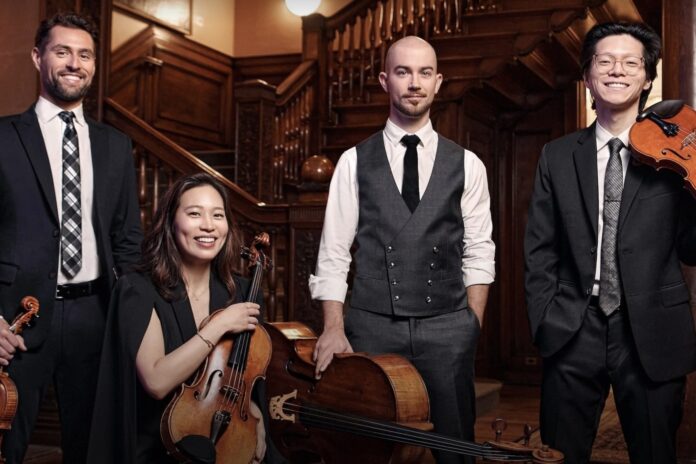
Pittsfield — The Dover Quartet will perform Sunday, September 21, at South Mountain Concert Hall, with a program of works by Haydn, Dvořák, and Mendelssohn. Formed in 2008 at the Curtis Institute of Music in Philadelphia, the Grammy-nominated ensemble is known for its technical precision, unified ensemble sound, and expressive interpretations. It takes its name from “Dover Beach,” a work by composer and Curtis alumnus Samuel Barber.
The quartet gained international recognition in 2013 with a sweep of all prizes at the Banff International String Quartet Competition. Additional honors include top awards at the Fischoff and Wigmore Hall competitions, the Avery Fisher Career Grant, Chamber Music America’s Cleveland Quartet Award, and Lincoln Center’s Hunt Family Award.
The Dover Quartet is the Penelope P. Watkins Ensemble in Residence at Curtis and Quartet in Residence at Northwestern University’s Bienen School of Music. Its 2024–25 season includes premieres of new works by Jerod Impichchaachaaha’ Tate, a citizen of the Chickasaw Nation, and collaborations with pianists Michelle Cann, Marc-André Hamelin, and Haochen Zhang. The group will also tour in Europe and Asia.
The group’s recordings include Beethoven’s complete string quartets, Schumann quartets, “Voices of Defiance,” and a Mozart album with violist Michael Tree. A new recording is expected for 2025.
The Dover Quartet’s program at South Mountain on Sunday will be as follows:
- Haydn — String Quartet in D Major, Op. 20, No. 4
- Dvořák — String Quartet in F Major, Op. 96, “American”
- Mendelssohn — String Quartet No. 6 in F Minor, Op. 80
Joseph Haydn’s String Quartet in D Major, Op. 64, No. 5, commonly known as the “Lark,” was composed in 1790 and is one of his most popular quartets. The nickname comes from the soaring first violin melody that opens the first movement, resembling a bird in flight. The quartet follows the standard four-movement structure: a lively Allegro moderato, a contemplative Adagio cantabile, a playful Menuetto, and a fast-paced Finale in sonata form. Showcasing Haydn’s wit, lyricism, and formal innovation, the “Lark” reflects his mature style and influence on the development of the string quartet as a genre of expressive depth and balance.
Antonín Dvořák’s String Quartet in F Major, Op. 96, known as the “American” Quartet, was composed in 1893 during his stay in Spillville, Iowa. Inspired by the landscape and sounds of America, the piece blends Dvořák’s Czech musical roots with American influences, including African American spirituals and Native American melodies. The quartet opens with a bright Allegro, followed by a lyrical Lento, a rhythmic Scherzo, and a spirited Finale. Its simplicity, strong melodic character, and folk-like charm make it one of Dvořák’s most beloved chamber works, reflecting both his love of nature and his openness to musical traditions beyond Europe.
Felix Mendelssohn’s String Quartet No. 6 in F Minor, Op. 80, is his final major work, composed in 1847 shortly before his death at age 38. Written in the aftermath of his sister Fanny’s sudden passing, the quartet reflects deep personal grief. The music is dramatic and intense, with a restless first movement, an urgent Allegro assai, and a deeply sorrowful Adagio. The finale bursts with agitation and emotional weight. Unlike his earlier quartets, which often balance lyricism and structure, this work is marked by raw expression and turbulence, serving as a poignant farewell from a composer overwhelmed by loss.
Hear the Dover Quartet on Sunday, September 21, 3 p.m., at South Mountain Concerts, 730 South Street, Pittsfield. South Mountain is located two miles south of Pittsfield center on U.S. Route 7 (South Street in Pittsfield). More information and tickets are available here.