My hunger for flowers was met this past weekend when my friend Cindy and I spotted a cornelian cherry in bloom while walking along Ramapo Road. The twenty-foot-tall tree was covered in the species’ starry blossoms, that are a bright yellow, for which I have less tolerance in mid-summer but that somehow seems magical and welcoming in late winter. Only one in a row of six cornelian cherries was in bloom, perhaps because it was sited closer to a stone wall or sheltered from the north winds. Whatever had given these buds the added incentive to burst forth so much earlier their peers, thoughts of botanical analysis faded quickly as, filled with sheer delight, we took in the beauty of these blooms.

I love this plant for its flowers, but also for its edible fruits, often used to make jam by Eastern Europeans. Due to its fruit, this tree is a source of sustenance as well as pleasure for me. I began to wonder if it grows in the Ukraine and when it might bloom there, imagining how the sight of its buds might bring cheer to the brave citizens of this nation fighting for its life. The flowers of edible plants have a way of giving us hope, as well as providing us with the promise of the bounty yet to come.
As I gave this further thought, I had the minor realization that the flowers themselves—for us often a reminder of the fruit to come—are an essential food source for pollinators. And while these early blossoms were enlivening my spirit, I tried to imagine how they appeared to bees at the end of a long, hard winter; perhaps it was the equivalent of a fully laden Thanksgiving table after a long fast.
This in turn, reminded me of a talk I heard recently by Dr. Doug Sponsler about the importance of food sources for pollinators throughout the seasons. Dr. Sponsler, a pollination researcher studying bee populations in Germany as part of his post-doctoral work, examines whether our gardens can help to sustain bee and other pollinator populations as they struggle to survive in an ever-developing world. The talk was filled with information on what pollinators need and, just like the possibility of Putin’s having a Potemkin army, Sponsler opined on whether we might be creating Potemkin gardens. He asks if our individual gardens really provide the resources to sustain an ecosystem and prevent species extinction, with a quarter of an acre here and there, or if we were merely providing the optics of a fully functioning ecosystem. I was intrigued to hear what he had to say on this topic.
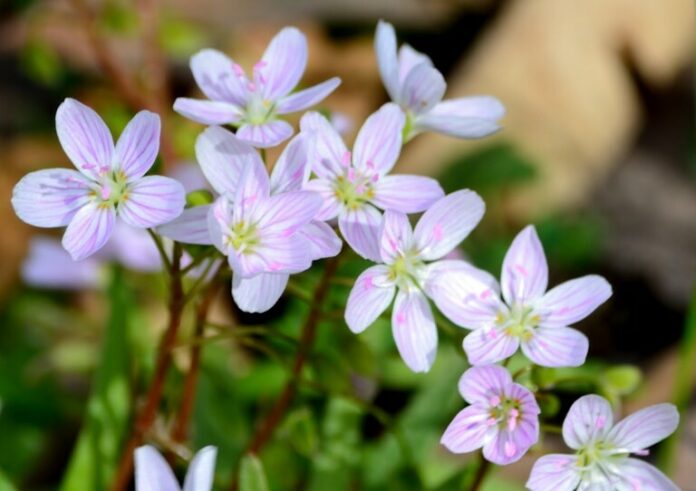
Before further exploring this topic, Dr. Sponsler shared advice on supporting pollinators that is both sensible and easy to apply: it is important to provide a variety of species that flower in a variety of forms and bloom throughout the season. Winter aconite and spring beauties help start the season off well for pollinators and provide sustenance at a critical moment but food sources are needed for pollinators throughout the season. Bees cannot, like us, go into the cupboard and retrieve a jar of Cornelian cherry jam; they need plants to bloom regularly throughout the months if they hope to meet their nutritional needs. Our home landscapes can provide some of this nutrition to local pollinator populations if we, as gardeners, think about successional flowering the way we think about successional planting of greens and other human food sources in our vegetable gardens.

Sponsler also spoke about shapes and forms, explaining how each pollinator species is typically attracted to a specific flower shape, i.e. cup-shaped flowers for some, tubular flowers for others. For this reason, if your goal is to help sustain a population of a favorite bird or bumblebee, it is important to have flowers of each shape in bloom for much of the season. He went on to say that the simplest forms of those flowers, those that display their stamens to the world, are more popular with pollinators than highly selected varieties with double flowers. As appealing as an overly petalled cultivar may be to a gardener, a bee will have a harder time finding its way into a peony or hellebore whose stamens are hidden by row upon row of petals. To my delight, this matches my own aesthetic preference; over the years I have come to see simple open petals with colorful stamens on display as the purest, most beautiful form of flower.

Taking in Dr. Sponsler’s information up to this point was inspiring, but I began to worry about what he would share with us about the effectiveness of our efforts. His talk was really aimed at more urban populations and whether their attempts to provide habitat made a difference to the survival of pollinator populations, but it could be applied more broadly as well. In fact, as he began addressing this issue, the crowd fell silent (at least it seemed so to me, although it’s hard to measure a hush on Zoom.) In so many words, he said he thought it unlikely that our work individually could rescue a species from extinction, softening this news with the argument that perhaps a collective effort could make some difference. It was painful to hear this, but his follow-up was philosophical and poetic and it has stayed with me since his talk. To paraphrase his simple statement: We cannot love what we do not name, and we cannot name what we do not see. And if we are to care for this world and love its inhabitants, our effort to sustain them in our own backyards is the first step in taking on our stewardship and broadening our understanding of their importance in the world.
Our actions may not always make the desired difference, but it does not mean that they are without purpose. I cannot help but see what is happening in the Ukraine, where all may be lost, as a metaphor for this connection to the natural world. It is important to take action and to give name to what we see and value. And this is a connection that I plan to uphold in my garden as well.
____________________________________
A gardener grows through observation, experimentation, and learning from the failures, triumphs, and hard work of oneself and others. In this sense, all gardeners are self-taught, while at the same time intrinsically connected to a tradition and a community that finds satisfaction through working the soil and sharing their experiences with one another. This column explores those relationships and how we learn about the world around us from plants and our fellow gardeners.