
Once, a long time ago, somewhere along the timeline between the civilization-defining moments of the discovery of fire and The Oscars Slap™, there was an elegant bit of computer software introduced that we called a “web browser.”
You might have known it as Netscape Navigator (née Mosaic) or Internet Explorer or Uncle Leo’s Window to the Web — a short-lived, dot-com-bubble-era challenger to the industry giants, funded with millions in venture capital inexplicably given to Uncle Leo “Sparkling Clean” Badarsky, who had, until that moment, been the proprietor of a New York City window-washing business.
Combined with a newfangled personal computer and a connection to the Internet provided by America Online or Prodigy or MindSpring or Earthlink or, briefly, Uncle Leo’s WebTastic ConnectOrama™ (his similarly unsuccessful follow-up venture), the early web browser was a modern miracle. It enabled us to easily find, say, a quirky personal website that might feature a list of food someone liked. Or maybe a website that featured a list of websites that featured a list of food someone liked. Or even a website that featured lists of websites that featured lists of websites that featured a list of food that someone liked.
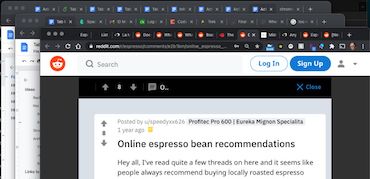
And that fascinating, life-enhancing, mid-1990s website information was presented in a single browser window that nicely filled the screen of your single computer monitor.
Oh, what I wouldn’t give to go back to those simpler times.
Because in 2002 — thousands of years after the discovery of fire and two decades prior to The Slap™ — the evil geniuses at the Mozilla Foundation, creator of the Firefox browser, integrated tabs into their product. We didn’t know it then, but at the very moment tabbed browsing began, our civilization was doomed.
First developed in 1998 by programmer Adam Stiles in his web browser SimulBrowse — just the name makes my brain feel like it’s being crushed in a vise — browser tabs are now an integral and truly horrible part of everyday life. Today we have multiple computers (and mobile phones and tablets), often connected to multiple monitors, each monitor displaying multiple browser windows and each browser window featuring dozens or hundreds or millions of open tabs.
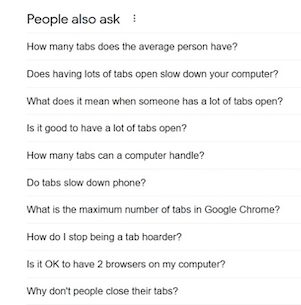
Clearly, it’s a crisis. We’re tab hoarders. We click “Open link in new tab” repeatedly, our hunger to multitask and acquire knowledge piled on top of knowledge is never satiated. Tabs for work projects. Tabs for half-read articles we’ll definitely finish later today (cough, cough). Tabs for recipes. Tabs for webmail. Tabs for social-media sites. Pinned tabs. Thirty-seven tabs for 37 different versions of loveseats you might purchase for your den. Tabs for articles about how to manage your tabs. Tabs for every column ever written by a certain Berkshire Edge columnist. Rinse. Repeat.
These open tabs are undermining our mental health, taunting us with knowledge we’re not quite sure what to do with — or when to do something with it. They remind us, endlessly, of the million-dollar idea we had four weeks or four months or four years ago that we still haven’t acted on. They sit quietly, tugging on our attention and adding a permanent, raised level of cognitive load to our already overwhelmed and distracted brains.
These tabs are a soul-sucking reminder of incomplete tasks, projects not started or completed, dreams unfulfilled, and, in my case, endless lists of food that someone likes that I still haven’t tried.
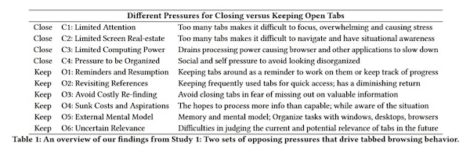
Last year a team of eight Carnegie Mellon University researchers — yes, eight! Too many, just like our tabs! — studied our use of browser tabs and published, “When the Tab Comes Due:
Challenges in the Cost Structure of Browser Tab Usage.” They found that more than 55 percent of us feel like we just can’t let go of our open tabs. And had they asked, they would also have found that fully 100 percent of us were stunned to discover that people actually get paid money to study browser tabs. (Click here to open their report in a new tab!)
There was a time when having too many open tabs would slow down or crash your computer. This was incentive to keep tabs to a minimum. But no longer: Modern browsers manage resources more efficiently, by, for example, only loading active tabs with memory-filling, processor-power-hogging data. Yet, even with these improvements and more powerful computers, our systems still sometimes crash from the load. And when that happens? According to the Carnegie Mellon study, many people felt relief that their tabs were gone.
Unfortunately, sadistic app developers rushed in to un-save the day. They added features that restore tabs from crashed browsers with one click. They want to make escaping your tabs impossible! What’s next? “Your browser closed unexpectedly. But don’t worry! We just emailed you a list of links to your tabs! And we’re FedExing a hard copy! You’re welcome, buddy!”
And the same software developers who created this torment keep offering alleged solutions: Tab managers to organize, snooze, preview, outline and report on our tabs. And plugins to organize tabs into groups, and then groups of groups, which we can label and share and link to, ultimately creating a labyrinth of browsers and windows and tabs and groups and groups of groups and links that even 100 Nobel Prize-winning mathematicians could not unravel were they given infinite time and infinite computing power and infinite cases of Red Bull.
So, how about a plugin to limit the number of tabs you can open? One that requires you to close a tab before adding a new one? Alas, someone created this for Google Chrome a couple years ago. To date, it’s been installed by … nine people. Not exactly a viral hit.
Or maybe one that quietly closes a tab that hasn’t been accessed for a certain amount of time? Would you even notice it was gone? Might you actually be deeply, utterly grateful, and happy to automatically send the developer a tiny crypto token for each disappeared tab?
That’s been done, too (without the crypto payments). A while back, a Silicon Valley programmer created a Chrome extension called Tab TimeOut that lets you set the number of minutes before a tab closes automatically. It’s clunky and not automatic and was only installed by 34 users (I was number 34). It was last updated four years ago this week.
But I bet someone could run with this idea of disappearing time-limited tabs, improve it, and launch “Uncle Leo’s Ultimate Tab Destroyer.™” It would be life-changing for millions or billions or potentially trillions of people. And with a name like Tab Destroyer, there could easily be a Marvel movie tie-in (“Tab Destroyer: The Browser Wars”) and maybe a profitable nutritional supplement (“Tab Destroyer Productivity Enhancer — Now with Ginkgo Biloba!”).
Another solution? Clicking “Open link in new tab” would deliver, in my long-favored method of human conditioning, a powerful-but-non-fatal electrical shock through your keyboard. I may be a man of peace and nonviolence but it’s time to face facts: We’re hopelessly addicted to tabs and only harsh, painful interventions like this can break the stranglehold tabs have on our lives and well-being.
Entirely credible research shows the total number of open-and-unread tabs across all people, computer systems, nations, planets and galaxies to be approximately 4.752 gigatrillion-billion-mczillion. These tabs are holding us back. They are weighing us down. They are standing in the way of moving forward with life. It’s time for them to die. So close all your tabs. Do it. Do it right now. And going forward only open a few at a time.
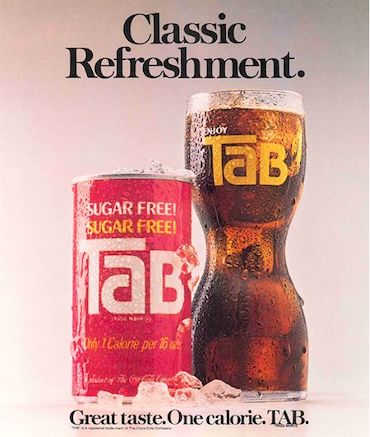
Related: A couple of years ago the Coca-Cola Company discontinued its original one-calorie soda, Tab, after more than a half-century of selling the barely refreshing, metallic-aftertaste-leaving beverage to millions of people. It’s not bringing it back. Few people miss it. And you won’t miss your open browser tabs, either.
With that resolved, we can finally address the other source of massive computer-related stress: The thousands of browser bookmarks you’ve created since the late 1990s that you never, ever looked at again.
Bill Shein is founder and president of Let’s Crush the Tabs, the non-profit organization behind “National Close Your Tabs Day.”