In my last column, while contemplating Great Barrington’s looming fiscal cliff, I examined new revenue sources. I noted that our school assessment (comprising 58 percent of the budget) and debt service (another 17 percent) were largely immovable objects. Well, that was not quite right. Short of declaring bankruptcy or a sudden collapse in interest rates, our bond obligations are set in stone. The school assessment, however, is another matter.
Regular readers of The Berkshire Edge are aware that Great Barrington’s contribution to the Berkshire Hills Regional School District (BHRSD) budget is out of whack. For over a decade, Chip Elitzer has used these pages and countless meetings across the state to argue for amended school funding legislation that aligns the state’s regional district funding formula with nearly every state outside of New England.
Here is Elitzer’s math problem that the Commonwealth’s legislators seem either unwilling to tackle or determined to avoid: Imagine twins, separated at birth. Each lives in an identical house with an identical property assessment—one in Great Barrington, the other in Stockbridge. Each sends one child to the same school, in the same classroom, with the same teachers. Yet the Great Barrington twin pays far more. Why? Because the current formula bills towns by headcount, not by property wealth—as if public education were a private country club charging dues per child.
Great Barrington sends 74 percent of the district’s students and will be on the hook for roughly $23.9 million next school year. Stockbridge sends 13 percent and will pay about $4.3 million. That gap is not a quirk of the math. It is the math.
Elitzer argues, correctly, that regional district funding should be based on equalized property valuations, a move that would align our district with the funding logic used by nearly every other state outside of New England. This should not be Elitzer’s crusade alone. He is right, and it is time we provided his eminently reasonable quest with our collective, vocal support.
Great Barrington voters have already signaled their support: At town meetings in both 2017 and 2019, the town voted virtually unanimously to petition the state for Elitzer’s proposed reform. In 2017, the town successfully amended the Regional Agreement to move capital costs to a valuation-based model; it is time we finished the job by doing the same for the operating budget.
This is not a new formula, but it is increasingly a burden. For more than 75 years, regional school assessments in Massachusetts have been tethered to student headcount rather than property assessments. The Regional Schools Act of 1949 was not born of malice; it was born in a different era. The towns that formed the first regional districts were overwhelmingly homogeneous farming and small-manufacturing communities. Property values among neighboring towns were broadly similar. There was no meaningful second-home market and no communities where half the housing stock sits empty from October to May. At the time, the headcount model made sense because, with roughly comparable property values per capita, the number of students each town sent to the regional school was a fair enough approximation of its share of the cost. Times have changed, but the formula remains stuck in 1949. The wealth disparities between neighboring towns simply did not exist at anything like their current scale. The founders of the regional school system could not have foreseen the inequity their formula has imposed on most towns today.
Massachusetts and other New England states stand alone in this arrangement. In most other states, multi-municipality school districts are independent taxing authorities that levy a single, uniform tax rate across the entire district. That means every property owner pays the same rate per dollar of assessed value, regardless of which town they live in. That is precisely the outcome Elitzer’s reform would achieve.
Because the lion’s share of public K-12 education is funded by local property taxes, taxable assessed value remains the perfect measure of a community’s ability to pay. To continue basing assessments on the number of bodies in a classroom rather than the wealth of the town is to treat a constitutional right like a private utility bill—essentially charging by the gallon for a public reservoir.
If our assessments were adjusted based on property valuations, as Elitzer proposes, Great Barrington’s share of the school budget would drop from roughly 74 percent to 52 percent. Stockbridge’s share would rise from 13 percent to 34 percent. West Stockbridge’s share would be minimally affected, rising from 12 percent to 14 percent. This is not an “ask” for a favor, but a demand for the restoration of a basic financing principle that has been ignored for decades: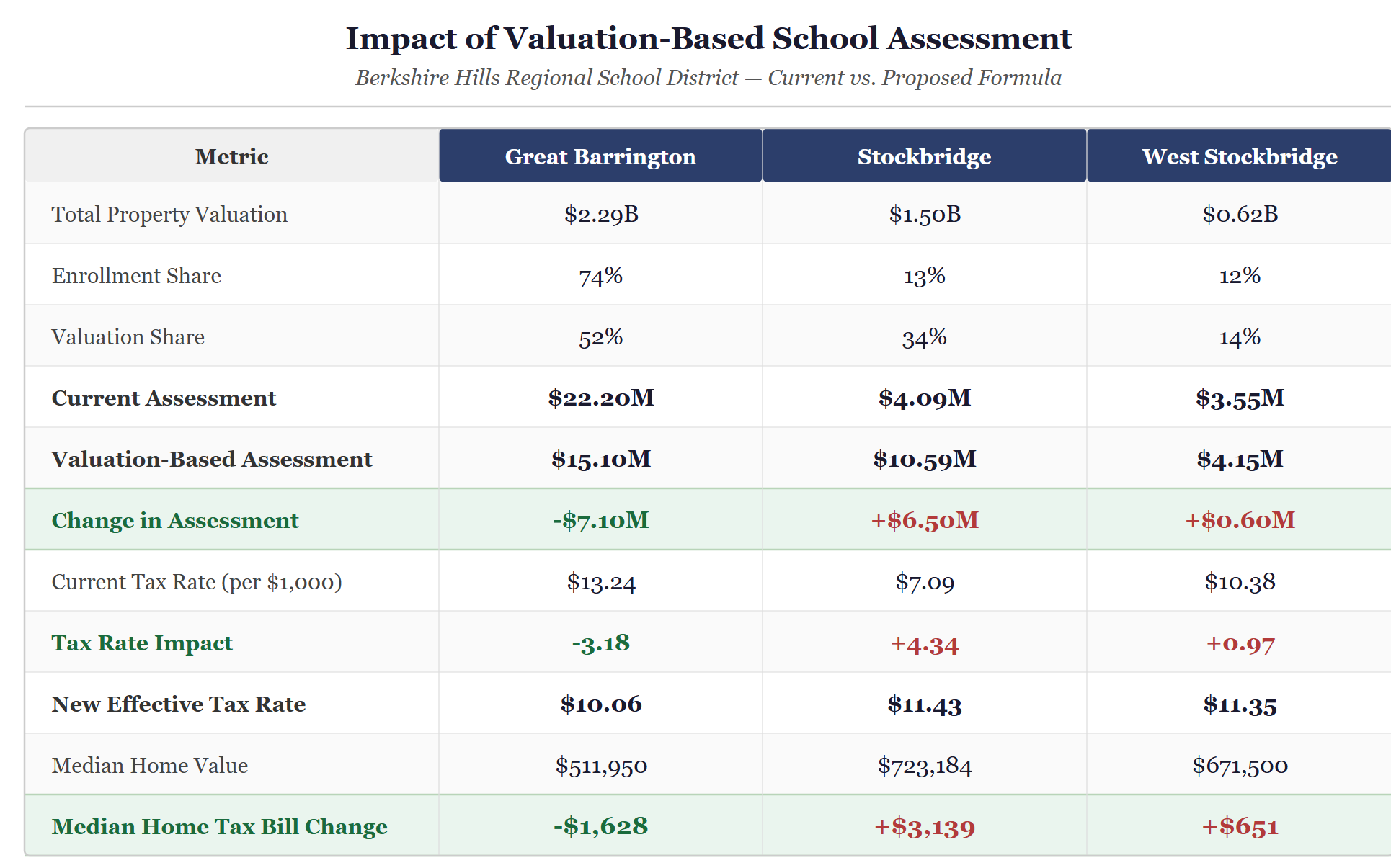
BHRSD is not alone in its inequitable funding. In the neighboring Southern Berkshire Regional School District, Sheffield taxpayers are affected most, paying a school tax rate almost seven times higher than an Alford taxpayer with identically assessed property. Fifteen districts have disparities exceeding two to one. Forty-seven regional districts have rate differentials of 10 percent or more among their member towns. Only 11 districts approach anything resembling equity. When 47 of 58 districts are affected, this is not merely a Great Barrington grievance. This is a structural flaw embedded in state law profoundly affecting taxpayers across the state. Across the state’s 58 regional districts, the inequitable formula causes overtaxed towns to pay roughly $118 million more each year than they would under a valuation-based model. Put another way, underpaying towns receive a subsidy of the same amount. When 47 of 58 districts show disparities exceeding 10 percent, the problem is not local, it is structural.
The formula is broken. The question is why the state, not known to favor inequality, continues to tolerate it.
If you live in Boston, your school taxes are based on your property value rather than on how many children your neighborhood sends to school. A Beacon Hill homeowner would never argue that because his block produces only a handful of students he should pay only a fraction of the school budget. Yet that is precisely the logic embedded in the regional school formula.
Elitzer’s proposal would transition each regional school district to a single district-wide tax rate for school purposes. The mechanics are straightforward: Divide the total school assessment by the total assessed property value across all member towns. Every property owner in the district would then pay the same rate per dollar of assessed value.
The impact for Great Barrington would be transformative. Under a valuation-based formula, the town’s school assessment would fall by more than $7.1 million per year. The tax rate would drop from $13.24 to roughly $10.06 per thousand dollars of assessed value, saving the owner of the median home approximately $1,628 annually.
West Stockbridge’s rate would rise, from $10.38 to $11.35 per thousand of assessed property valuation, and Stockbridge’s rate would rise, from $7.09 to approximately $11.43 per thousand. For Stockbridge, that increase would be significant, and no one should pretend otherwise. But it would align Stockbridge with the same principle that governs more than 84 percent of Massachusetts taxpayers who live in non-regional (unified) districts: You pay in proportion to what you own, not in proportion to how many children your town produces.
To be clear, no one is proposing that Stockbridge taxpayers wake up one morning to a $3,139 increase on their tax bill. As Great Barrington voters endorsed at a special town meeting in 2017, the transition would occur gradually. Great Barrington’s assessment would hold steady, absorbing no further increases, while Stockbridge and West Stockbridge assessments rose incrementally through inflation until the towns converged on the same rate.
Not for a lack of trying, Elitzer has little to show for years of work. The obstacle is political, not intellectual. Eighty-four percent of Massachusetts voters live in cities and towns with their own school districts and are unaffected. Among those who do live in regional districts, 42 percent would see their taxes increase under reform. No town meeting in a “winning” town will voluntarily vote to raise its own assessment, and few legislators have an obvious incentive to champion a reform that would do exactly that.
Elitzer’s intellectual case is airtight. The principle is sound, the math is clear, and the inequity is indefensible. But intellectual merit alone has not been enough. After a decade of advocacy, a different strategy is needed. That, dear reader, will be discussed in our next column.
Survey Monkey Question
Here is a link to the following survey: Should every property owner in the school district pay the same tax rate for education, regardless of which town they live in?
Survey Monkey Results
As of publication, our readers have shown a strong mandate for new revenue paths:
- Resident Parking Decals: 66.07 percent Yes
- Stormwater Utility Fee: 70.91 percent Yes
- Real Estate Transfer Fee ($1M+): 78.57 percent Yes
- PILOT Program: 82.46 percent Yes