You have seen in this space that putting the cracked housing market back together again requires many minor adjustments in the absence of any silver bullet. Now that the proposed real estate transfer fee is gaining momentum with support from politicians and newspapers alike, let’s turn to one adjustment that, along with the proposed fee, can have a beneficial impact on workforce housing in Great Barrington.
Let’s discuss Area Median Income (AMI). No, wait, don’t go. Vickie Shufton’s, Sheela Clary’s, and Carole Owens’ columns will still be there in a few minutes. Can’t we just talk about AMI for a moment?
AMI is what people talk about when they talk about fixing the housing imbalance. Correcting the federal government’s AMI calculation for the southern Berkshires will unlock various housing benefits. Wait, please, let me explain.
AMI is calculated by the Department of Housing and Urban Development (HUD) using census income data as reported on detailed census returns. Nearly every housing program—low down payments, guaranteed loans, developer incentives—are tied to an area’s AMI. AMI is arguably the single most critical input in the housing equation, as it is the one data point used to determine eligibility for a host of housing programs.
If an applicant earns up to 80 percent of AMI, government programs step up to assist renters and home purchasers and incentivize developers—although its principal use is to promote the rental housing market. Exceeding 80 percent of AMI can be very unrewarding.
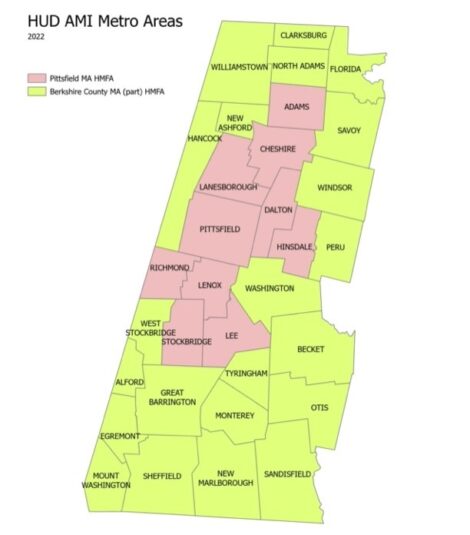
HUD miscalculates AMI for the southern Berkshires not mathematically but geographically. I have no reason to believe that the median household income that HUD calculates for each Berkshire County town based on census data is incorrect. But then HUD rolls various towns into a regional AMI. HUD’s mistake and our problem is the map that HUD uses.
For some unknown reason, HUD calculates only two AMIs for the county: one for the towns immediately surrounding Pittsfield (think donut hole), and one for all the other towns north and south of the Pittsfield-area donut. The problem is that the towns in North County have neither proximity nor basis for being included in South County’s AMI calculation. In an economically diverse county, lumping North County and South County makes no sense. This is the geographic correction we need.
If Berkshire County were split into three AMI zones, think a nice layer cake, the calculation would more accurately reflect each zone’s average median income. This would result in South County’s AMI being higher, which would favorably impact those distressed by rental rates and loans rates and in need of housing assistance.
At present, when North and South County towns are lumped together, the AMI for the combined area for a family of four is $81,960 (or $57,420 for an individual). When you divide Berkshire County into three zones, the AMI for North County is $75,589 and the AMI for South County is $89,227. With a nudge to HUD and the slip of a pen turning a donut into a three-layer cake, South County’s AMI goes up about 10 percent.
Ten percent may not make you ecstatic, but it is not nothing. Just as the transfer fee is a part of the solution, this is a little bit that can help. It wouldn’t cost HUD more than a few dollars to redo the AMI map. Granted, these are singles not home runs, but there is no known panacea for our housing ills. Small ball wins games too.
AMI makes a difference to developers, because apartments priced above 80 percent of AMI are not eligible for subsidized housing benefits. AMI makes a difference to banks, which are encouraged by regulators to lend to this portion of the housing sector under the Community Reinvestment Act. (And by “encouraged,” I mean that bank regulators strictly monitor banks’ compliance.) Towns want to assist in construction of eligible housing units because each town has a 10 percent affordable housing requirement under state law.
A favorable AMI unlocks all sorts of benefits for renters and developers; rather than fighting with landlords and banks, all parties are rowing in the same direction for their mutual benefit. Currently, AMI is a very real barrier to housing progress that none of us see. Teachers, police officers, and medical professionals, for example, may earn above 80 percent AMI and, therefore, be unable to access any of AMI’s golden benefits but still not earn enough to buy a home in the area.
If we can convince HUD to reconsider its donut-Berkshire County map to put like towns together in its AMI calculation, we will start getting somewhere. The point is, the housing ecosystem is based on one number which, for South County, inaccurately reflects the area’s true AMI. This needs to be fixed.
The fact is that the single most pressing problem we face in South County is lack of housing. If we are unable to solve this problem, no one will want to live here and no one will want to work here. Housing advocates have been spreading this news for some time. Now it is time for business owners to start beating the drums loudly too. If you own a business and you cannot staff your business, you should be on the front lines of this fight. This is all hands on deck time, and we are looking at you, businesses.
When we moved to Great Barrington five years ago, I had trouble understanding why my local news came from the capital of a state that I decidedly did not want to live in, and I could not get any news from my state’s capital. Unless the FCC wanted everyone in Berkshire County to be pleased with their decision to live in Massachusetts, the FCC’s Designated Market Area (DMA) lumping Berkshire County in with Albany, N.Y. made little sense. But after the ruckus got loud enough, Senator Markey was able to obtain some favorable adjustments to the FCC’s DMA for Berkshire County. We need to make some South County AMI ruckus now. We need our representatives to implore HUD to revise its South County AMI map.
So, dear Senators Warren and Markey and Representative Neal, can you help us out here? We are not at this moment asking for monetary assistance (that will come later). The donut we find ourselves in is illogical and detrimental. We are simply asking HUD to re-bake the map, which should be a piece of cake. Would you please implore HUD to what would amount to a minor change to HUD but might make a world of difference to someone trying to get housed? Feels like an easy ask.