Editor’s Note: Last week, the New England First Amendment Coalition and several national advocacy organizations denounced the recent detention of Tufts University Ph.D. student Rümeysa Öztürk by federal immigration authorities. NEFAC, the Student Press Law Center, Freedom of the Press Foundation, PEN America, and other organizations said the detention appears to be a “blatant disregard for the principles of free speech and free press within the First Amendment.” The following editorial was co-authored by Justin Silverman, executive director of the New England First Amendment Coalition, and Josh Moore, assistant director of the Student Press Law Center.
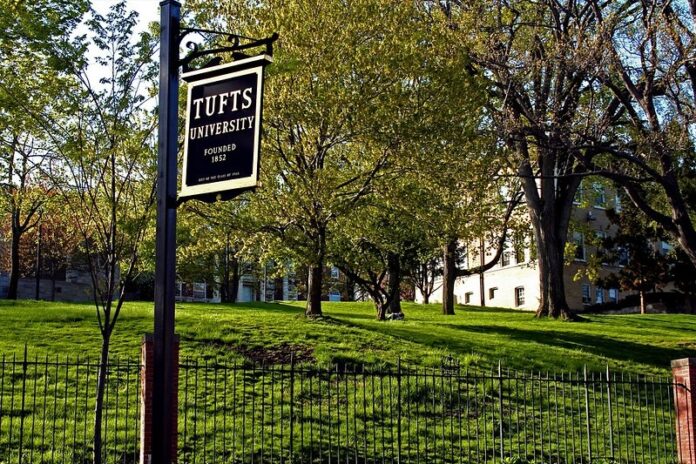
On March 25, masked federal immigration authorities detained Tufts University Ph.D. student Rümeysa Öztürk for engaging in what Trump administration officials said were “activities in support of Hamas, a foreign terrorist organization that relishes the killing of Americans.”
Öztürk’s attorney, however, has said she is not aware of any criminal charges against the student and when asked to detail the specific activities warranting the student’s visa being revoked, U.S. Secretary of State Marco Rubio would not do so. Meanwhile, a Tufts spokesperson has said Öztürk is a student “in good standing.”
The only publicly known activity one might tie to Öztürk’s detention is an op-ed she penned for The Tufts Daily more than a year ago—a column critical of the Israel-Hamas war but one that university officials said did not violate campus policies on protests and expression.
If this is the basis for her detention, Öztürk’s current incarceration is a blatant disregard for the principles of free speech and a free press. It is also a warning to student newsrooms that mere criticism of government can be punished despite protections for such speech entrenched in our country’s history and enshrined in our Constitution.
The Student Press Law Center and the New England First Amendment Coalition—joined by other journalism advocates such as Freedom of the Press Foundation and PEN America—are asking the Tufts administration to: (1) publicly demand that ICE release Öztürk; (2) clarify that her detention undermines the university’s values; and (3) reaffirm protections for international students’ free speech rights.
While Öztürk’s op-ed is critical of the Israel-Hamas war, many Americans across the political spectrum, regardless of where they were born, share similar concerns. Öztürk and her co-authors say nothing in the op-ed remotely supportive of Hamas or terrorism. Instead, they focus on their university’s actions and call upon the administration to engage with and listen to its students. This is precisely the type of speech that should be welcomed and protected at universities.
The opinion pages of student newspapers have a long tradition of open dialogue and debate on the important issues of our time. Students must have the room to lawfully express themselves free from government interference. Rounding up a student for an article that she published is a clear attempt to silence speech and interfere with Öztürk’s First Amendment rights.
This alarming incident is the latest example of the Trump administration unlawfully targeting student speech. Mahmoud Khalil was arrested on March 8 for his peaceful protest and social media posts while attending Columbia University. Khalil’s case marked the beginning of a dangerous pattern of using immigration enforcement to punish dissent, a tactic straight out of the playbook of authoritarian regimes. Our country must not follow the lead of authoritarian governments it has worked for decades to counteract by weaponizing visa status against criticism. When students face detention or deportation for lawful expression, it sends a message to all that the price of dissent is exile.
In response to Öztürk’s arrest and other detentions, international students are now removing social media posts and refraining from political speech altogether. This is a violation of our First Amendment right to hear from and associate with noncitizen students, according to a lawsuit recently filed by several academic associations against federal officials. The Trump administration’s ideological-deportation policy, they argue, makes it more difficult for them to learn from these students. Student speech is now chilled due to the “all-too-real possibility” that noncitizens “will be arrested, imprisoned, and deported for exercising rights that the Constitution guarantees.”
The First Amendment is an asset, not an inconvenience. Citizens and noncitizens alike are entitled to free speech. Institutions that value free speech rights don’t seek out opportunities to disregard them. Student visas may be the lowest-hanging fruit for now, but those who revoke visas of op-ed writers are sure to seize upon any legal theory that might permit them to punish others with whom they disagree. Academic freedom cannot thrive if students face deportation for participating in campus discourse, and there is nothing more central to the American tradition of free speech on campus than student commentary on U.S. foreign policy.
Journalism is not a crime. Criticism is not a crime. They are instead essential parts of a healthy democracy, one that we are seeing quickly erode. This effort to chill dissent may start with students, but it likely will not end there. If the federal government can punish a student for an op-ed in a campus newspaper, what will prevent it from doing so with professional journalists and others with whom it disagrees?