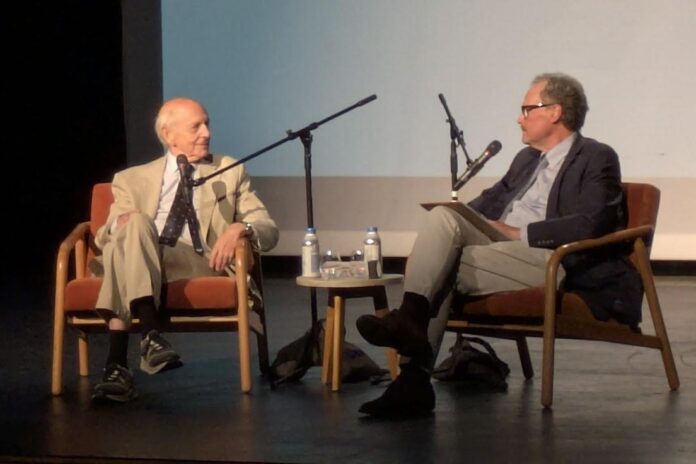
Lenox — Retired Supreme Court Associate Justice Stephen Breyer spoke about his latest book “Reading the Constitution: Why I Chose Pragmatism, Not Textualism” at an event at the Duffin Theater on Friday, August 1, as part of The Mount’s “In Conversation” discussion series.
During the event, Breyer spoke to former John Simon Guggenheim Memorial Foundation Vice President André Bernard about his book which was released in March 2024.
Then-President Bill Clinton nominated Breyer for the Supreme Court in 1994. He subsequently served on the Court for 28 years, up to his retirement in 2022.
Before the event started, The Mount Executive Director Susan Wissler told the audience that while Breyer would answer questions from the audience towards the end of the event, he would not “answer questions pertaining to the current political climate or cases that are pending or likely to come before [the Court].”
Also before the event, The Mount’s Director of Marketing and Communications Jennifer Young emailed The Berkshire Edge that “Press cannot ask questions. Photos are allowed but only for the first two minutes of the talk.”


During the event, Bernard asked Breyer about his book and his experiences during his time serving on the Supreme Court. “What was it like to walk into the court as a justice?” Bernard asked Breyer. “You had been there before as a clerk.” “I was intimidated,” Breyer said. “[Late Supreme Court Justice William Douglas] said that it takes two to three years before you adjust. You might think to some degree, ‘Well, can I really do this? I know I’ve been saying that I can and I have all of my friends who say I can, but now I have to really do it.’ I did get some very good advice from the president. He said, ‘I’ll tell you, the applause dies away very fast, much faster than you think. You’re left with the job, so you better like it.’”
“You said an interesting thing [in your book] about becoming a new justice,” Bernard said. “You said that new justices must think about what will work best for the Court and the country.”
“That’s a corny statement, but it’s absolutely true,” Breyer said. “[If you] try to do this to please a group [of people], forget it.”
Bernard read an excerpt from Breyer’s book: “Each case is a new day. The basic job is one of making decisions. You can change your mind, but do not do it too often. And of paramount importance, personal relations on the court are typically good. Keep them that way.”
“I believe in that very strongly,” Breyer said. “When I say that you can’t change your mind too often, it is the job of the judge to decide. It’s not like the job of a lawyer to put out some great theory. It is to decide the case.”
As for writing a dissent to a majority decision, Bernard quoted Breyer as writing, “When you become a judge, if you disagree with an opinion, write out your true feelings, then tear it up, sit down, and rewrite it as a judge’s dissent.”
“John Wisdom, a Fifth Circuit judge, told me that,” Breyer added. “It was that Fifth Circuit that desegregated the South. My own approach to when I really disagreed with the majority [of the Supreme Court] concerning a decision is I’ll write [the dissenting opinion] in a style that I think a child of two would. I’m not going to say anything rude [about the decision], I’m just going to say, ‘one and one is two.’ I don’t want to be too rude about people I’ve met who disagree with me. Sometimes they have turned out to be right.”

Breyer said that much of the law and many Court decisions come down to interpretation. “What does it mean when my wife says, ‘We have no butter?’” Bryer said. “She doesn’t mean that there’s no butter in either Plainfield, N.H., or Cambridge, Mass. She means when she says there is no butter, there is no butter in the refrigerator. But she doesn’t say that. She says there is butter, but as usual, you can’t find it.”